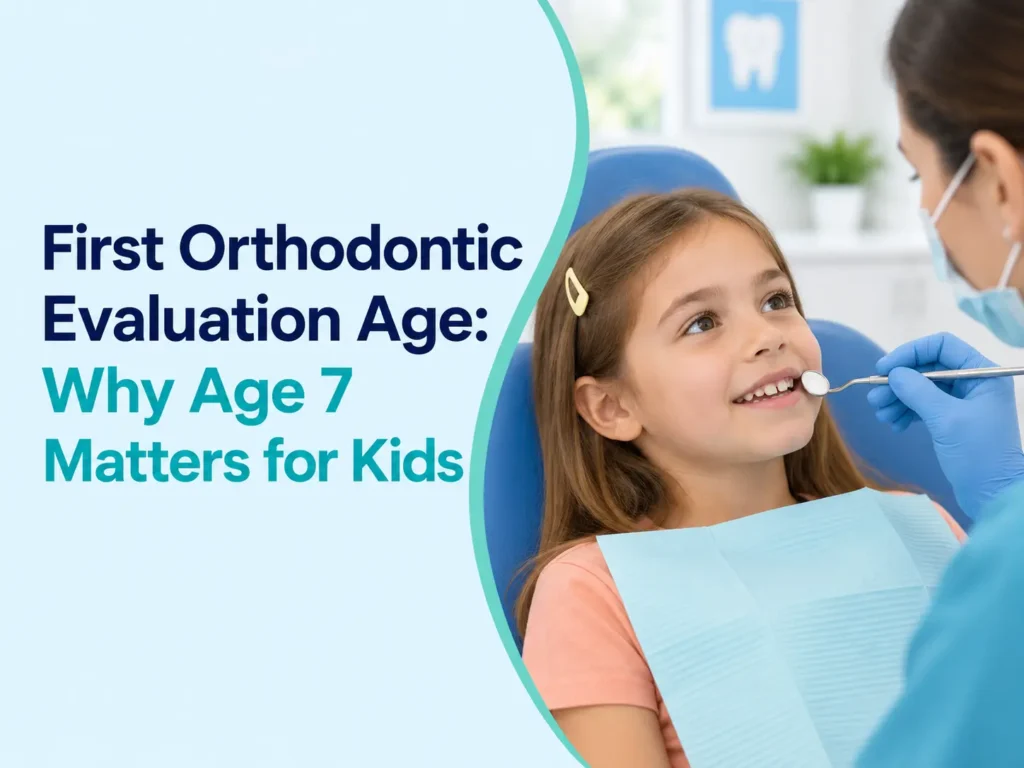
First Orthodontic Evaluation Age: Why Age 7 Matters for Kids
Seven may sound young for an orthodontic visit, especially when your child still has several baby teeth. However, the recommended first orthodontic evaluation age is 7. The goal is not to put every second grader in braces. It is to see how new teeth are arriving, how the upper and lower teeth meet, and whether growth should be watched or guided.
This early look can identify a concern or confirm that no treatment is needed.
Why Is The First Orthodontic Evaluation Age 7?
By age 7, many children have permanent back and front teeth. They reveal useful clues about space and how the bite is forming. The mouth is also still growing, leaving time to respond when a problem needs early attention.
The American Association of Orthodontists recommends a checkup by age 7. This recommendation is about timing and planning, not automatic treatment. Dr. Parsi helps parents understand what looks normal, what should be watched, and when a focused orthodontic evaluation may be useful.
What Can Early Evaluation Find?
Straight front teeth do not show everything. An evaluation checks incoming teeth, available room, and how both rows work together.
Limited Room for New Teeth
Permanent teeth are larger than baby teeth. Without enough space, they may overlap, turn, or appear behind other teeth. Finding this early supports better planning through early orthodontic care.
Teeth That Meet Unevenly
The orthodontist checks whether the upper teeth sit too far ahead, the lower teeth sit in front, or one side closes differently. These problems can affect chewing even when the smile appears straight.
Teeth Arriving Off Schedule
Losing a baby tooth very early or late can affect its replacement. Pictures may also reveal a permanent tooth heading in the wrong direction.
Which Early Braces Signs Matter?
One unusual tooth does not prove treatment is necessary. Consider an evaluation before age 7 when eating, tooth position, or the way the mouth closes appears unusual.
Early signs your child may need braces or monitoring include:
- Crowded, overlapping, or widely spaced teeth
- Difficulty biting into food or chewing evenly
- Upper and lower teeth that do not meet correctly
- Front teeth that stick out noticeably
- Baby teeth lost unusually early or late
- Thumb-sucking that continues beyond early childhood
- Regular mouth breathing when the child is not congested
- A lower jaw that shifts when the mouth closes
Bring these observations to the appointment. A short video can help show a jaw shift that does not happen during the visit.
What Happens at the First Visit?
A youth orthodontic evaluation gathers information. The team reviews dental history, habits such as thumb-sucking, and concerns about chewing, spacing, or incoming teeth.
Conversation and Smile Check
The provider checks both rows of teeth, available space, and how the mouth closes. Dr. Parsi helps children understand each step while explaining what may need attention now or later.
Pictures When Helpful
Photographs or digital dental images may be suggested when the provider needs to see teeth that have not appeared. Parents can ask why an image is needed and how it will affect the recommendation.
Does Age 7 Mean Braces?
Usually, no. An age 7 orthodontist screening commonly leads to one of three outcomes:
- No action: Everything looks on track, and routine dental visits continue.
- Monitoring: The child returns periodically so changes can be checked as permanent teeth arrive.
- Early care: A specific problem would be easier to manage while the child is still growing.
Ask the provider to name the problem, explain what waiting may change, and describe the expected benefit. If the need remains unclear, another professional opinion can support a confident decision.
How Does Phase 1 Compare?
Phase 1 orthodontics for children addresses a specific early problem. Later braces place permanent teeth in their final positions. The stages have different goals.
| Phase 1 care | Later braces |
| Used only when early action offers a clear benefit | Usually begins after most permanent teeth arrive |
| May create room, improve how teeth meet, or stop a harmful habit | Straightens and fine-tunes the permanent teeth |
| Often followed by a period of monitoring | Followed by a retainer to help preserve results |
Some children who receive two-stage orthodontic care still need braces later. Early care should therefore solve a defined current problem, not be presented as a guarantee that future treatment will be avoided.
How Can Parents Prepare?
Describe the appointment as a simple visit to see how the child’s teeth are growing. Avoid promising that there will be no pictures or treatment because the recommendation depends on the evaluation.
Bring requested records and written concerns. Ask whether the next step is no action, monitoring, or treatment. When arranging children’s orthodontic visits, also ask how often follow-ups are needed.
Schedule The Right Orthodontic Check
The recommended first orthodontic evaluation age is 7, but visible problems may justify an earlier visit. The purpose is to learn whether development is on track, should be monitored, or needs timely help. A clear evaluation gives parents a plan without assuming every child requires immediate braces.
Why Choose Wellesley Pediatric & Orthodontic Dentistry?
Wellesley Pediatric & Orthodontic Dentistry helps families clearly understand how children’s teeth and bites are developing. Dr. Parsi explains findings in clear language, supports children through each step, and helps parents understand whether monitoring or further evaluation is appropriate. Families receive practical guidance based on their child’s current needs and growth.